Description
The affordance of voice and embodied, spatial interactions in virtual reality social spaces has brought about new challenges for moderation in these emerging virtual communities. As VR social spaces gain popularity, ensuring user safety—by moderating its ephemeral and real-time content—becomes critical. As part of the UC Berkeley BEST Lab, this research project explores how conventional strategies of moderation and privacy for 2D virtual communities (like Facebook and Reddit) apply to 3D, immersive environments of VR social spaces.
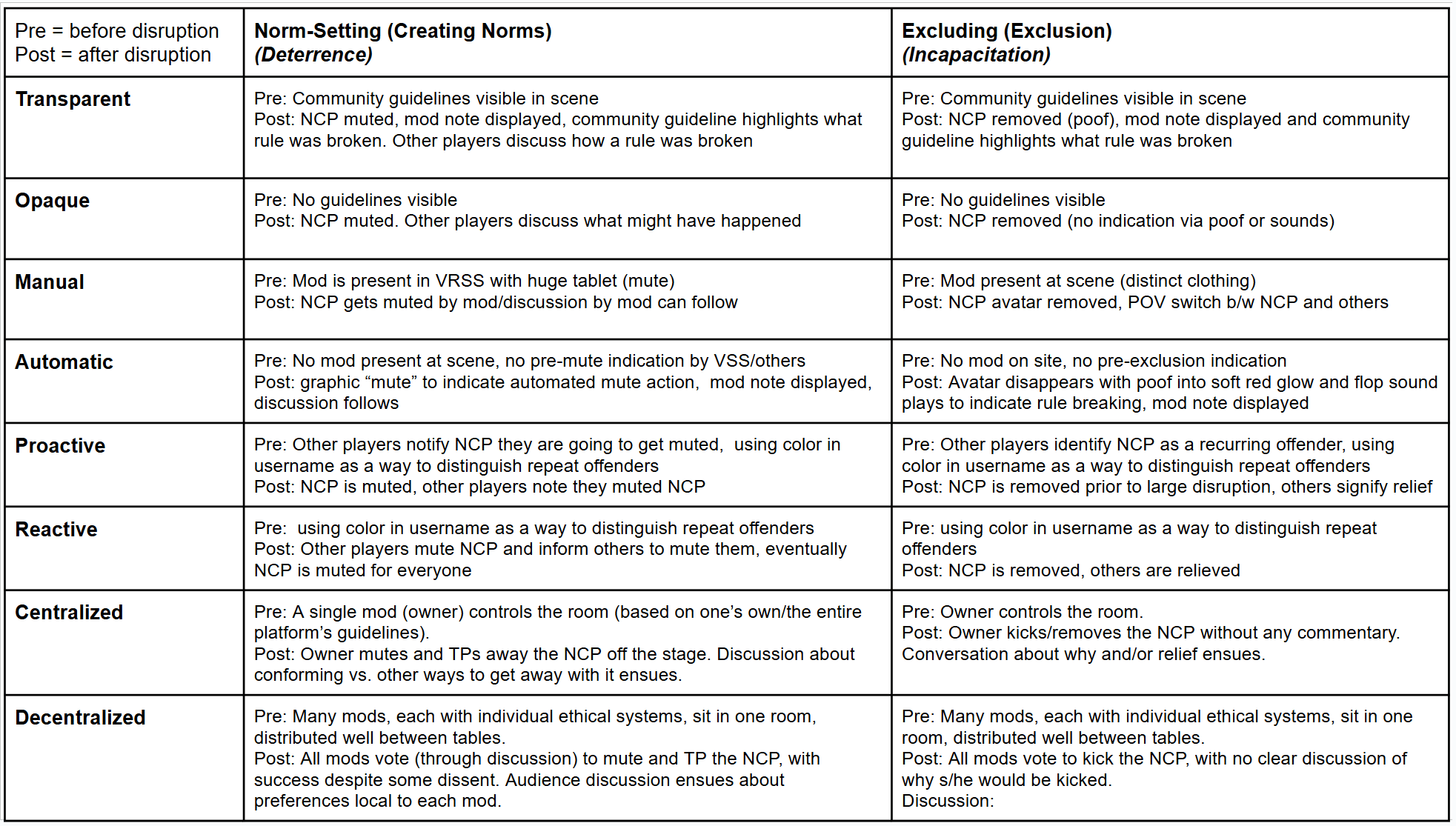
The guiding questions for this project was: How can VR social spaces be designed to prevent harassment and to encourage prosocial behavior? For the experiment, we built a series of vignettes in Unity which depict a non-compliant player disrupting a VR social space, followed by a moderation response utilizing one of the sixteen strategies we outlined.
Date: August 2019-January 2021
Collaborators: Dr. Vivek Rao, Prof. Alice Agogino, Jessie Mindel, Resham Khanna, Imaani Choudhuri, Aravind Ravikumar
My Contributions: lead student researcher, project manager, experiment design, lit review, translating moderation strategies to simulated scenarios, VR scene development and interaction design
Motivation
Social VR is an inevitable and necessary application of virtual reality that will have a profound impact on the way we communicate and build community. According to VR expert Jeremy Bailenson, the issue that developers are currently most concerned with when it comes to social VR apps is how they will effectively mimic the nuances of real human interaction and non-verbal communication. While this is an important issue to tackle in order to create better social VR experiences, developers also need to prioritize designing for user safety. Despite the rising popularity of VR social spaces and established guidelines in platforms like AltSpaceVR and the emerging Facebook Horizon, there is little rigorous understanding of how moderation and privacy practices apply to immersive 3D environments.
Virtual reality experiences are analogous to real life experiences in terms of their impact on human brains, so the stakes are high when it comes to embodied social interactions. Lindsay Blackwell's 2019 paper Harassment in Social Virtual Reality: Challenges for Platform Governance highlighted how physical and verbal harassment in the virtual world can feel like real-life harassment. Moreover, there is a lack of consequences for disruptive actions in most popular VR spaces. With no widely accepted guidelines in VR social spaces, there are real threats to the safety of social VR users.


Experiment
We drew on moderation and responsive regulation theory to inform our study. We used James Grimmelmann’s “grammar” taxonomy of moderation. From his 2015 text The Virtues of Moderation, we combined ‘verbs’ (e.g. exclusion and norm-setting) with paired ‘adverbs’ (e.g. transparent/opaque, manual/automatic, proactive/reactive, and centralized/decentralized) to create a moderation design space with sixteen moderation strategies adapted to a VR social space. We also incorporated responsive regulation into the design of scenarios, accommodating what Blackwell described as “emerging norms” in VR social spaces that warrant different types of norms enforcement, identifying discrete levels of regulation that deliver consequences to breaking norms:
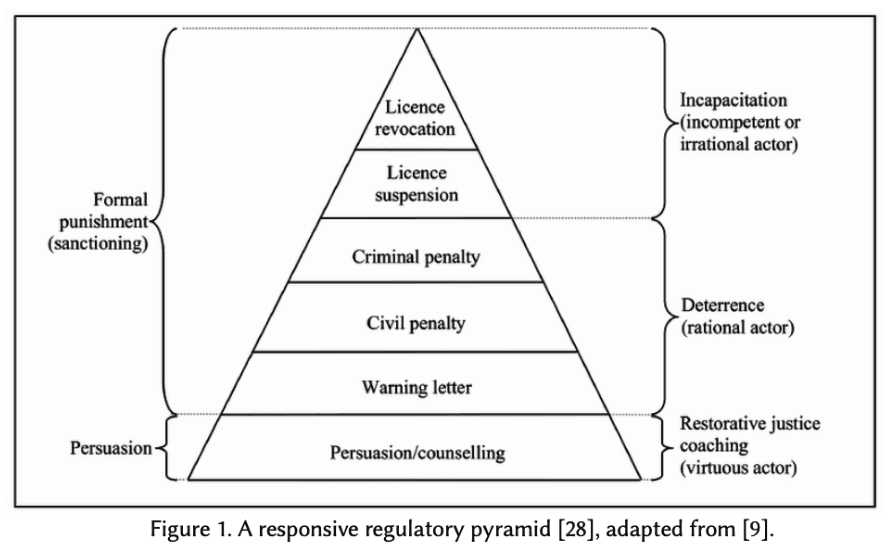
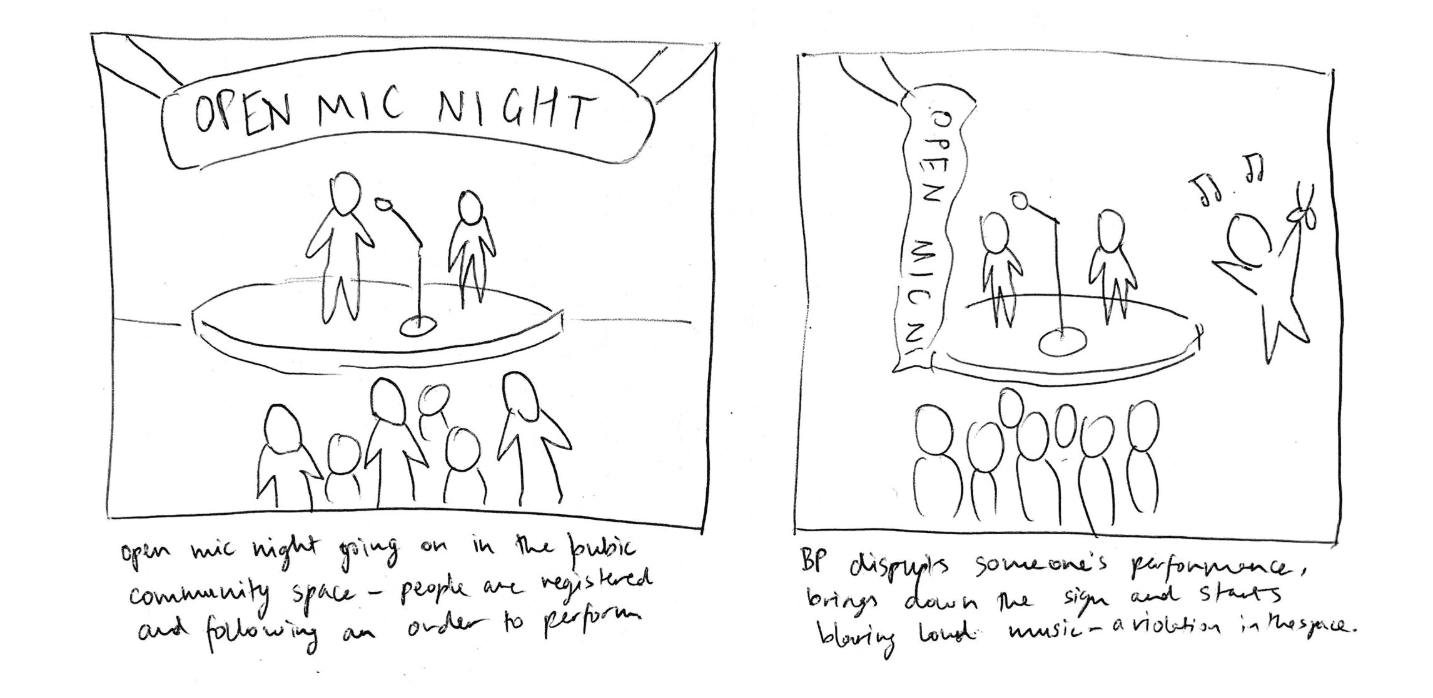
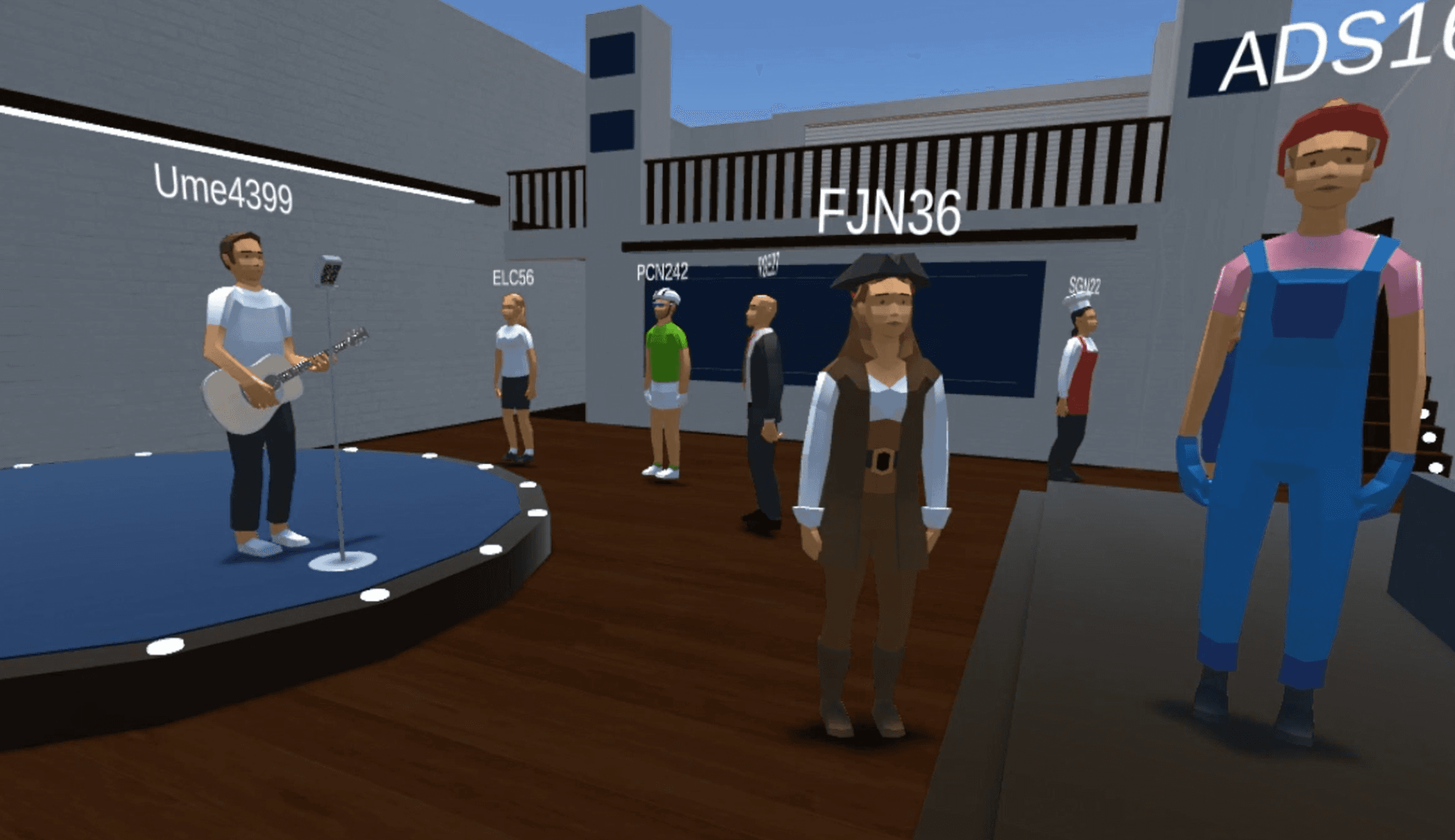
Based on these models, we built sixteen simulated VR social spaces interaction, with a representatively immersive environment and dialogue. Each scenario was developed in Unity, simulating a social space with 10-15 participants who collectively observe a participant breaking norms of the space by rudely disrupting an open mic night event. A different response occurs in each scenario, depicting one of the moderation strategy responses to the same disruption. Each scenario was around two minutes long and had the same key assets and elements, with only the moderation response differing.
Note: The research project continued after I had graduated and started working at Microsoft. Due to Covid-19, we were unable to complete the in-person studies as originally planned. The team adapted to an online survey, which was conducted post my active involvement with the group, which is why findings are not included here.