Description
Masked as a VR video game, Survival Ad-venture is an immersive experience built in Unity, that serves as a critical commentary on the pervasiveness of intrusive, targeted advertising. A user is stranded in a remote environment and is instructed to complete tasks that teach survival skills. Based on the user’s decisions in the game, the VR space becomes increasingly cluttered with seemingly relevant billboard ads that beckon the user to buy goods or services in “real life.” Survival Ad-venture aims to highlight and immerse us in the unsettling, overwhelming, and distracting nature of the targeted advertisements that we constantly navigate through in our lives. Additionally, as VR is an emerging technology, this project provokes questions of how advertisers might utilize this new space to collect data and deliver targeted ads.
Date: November 2019
Collaborators: Will Oakley, Katherine Song, Kyle Trieu
My Contributions: proposing concept, scene development in Unity, ideation and design, game flow
Motivation
During my team's brainstorming and ideation process, I suggested ideas centered around creating commentaries on:
Social media and how it creates artificial connectedness & isolation
Social media and the fake news & bots
Consumerism and the overwhelming nature of advertisements
My third idea resonated most with my group. We wanted to showcase how advertisements can play a role in virtual reality spaces. Advertisements can greatly affect how virtual reality is approached and the way that ads are portrayed can make or break VR experiences.
We discussed how digital advertising tactics and trends have changed throughout time, and how we wanted to reflect this change. In the early 2000’s, ads were often flashy and attention grabbing, consisting of popups and bright colors. In the past few years, ads have taken much more of a subtle and nebulous approach, gathering information about users and presenting information in a way that makes consumers subconsciously revert to using the advertised products. We settled on a hybrid of subtlety and gaudiness. When interacting with objects within the space, ads are populated on billboards, “curated” to one’s tastes. The generated ads would relate to whichever objects the user interacted with, showing the aspect that data gathering plays within advertisements today. We intend for this action to be slightly offsetting and striking for the user.
By containing this experience within virtual reality, we wanted to showcase that people can never really escape advertisements. Within this digital world, ads can be even more nefariously placed. The entire generated scene around the user reacts in real time to the decisions they make, linking them back to objects and experiences in the real world.
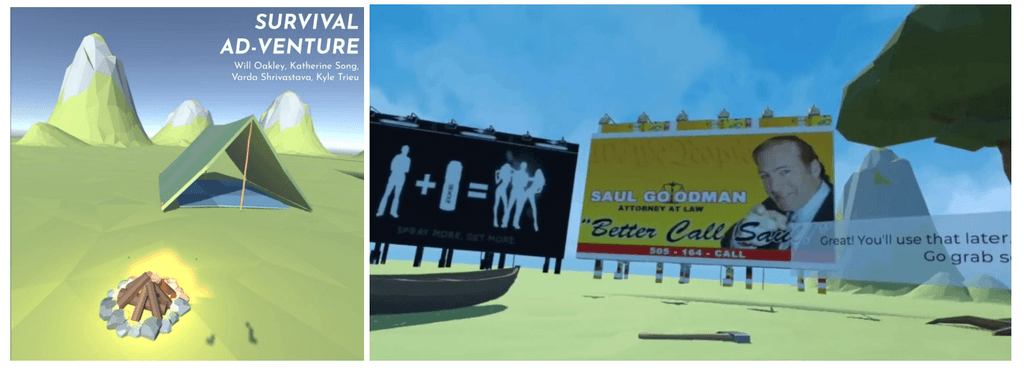
We wanted to replicate the common situation of someone thinking that they signing up for an entertainment experience but is quickly drawn into a world where no step goes unnoticed or unused by advertisers, who shamelessly bombard the user with ads. In real life, the experience of receiving advertisements sometimes goes completely unnoticed or ignored, but when it is noticed, it is oftentimes overwhelming, unsettling and creepy, and also on occasion does in fact align with a user’s desires. We wanted to use VR to create an immersive experience that highlights and captures a few of these sentiments. We focused on a few characteristics and tried to evoke those as follows:
Overwhelming - Ads are plastered everywhere, and we are constantly overwhelmed and distracted by ads. This was one of the main commentaries that inspired our project, so we wanted to make sure that this was captured. We bounced between the ideas of having pop-ups or billboard ads. Pop-ups had the advantage that they would be more distracting and would prevent the user from moving through the game, but we wanted to take advantage of the immersive aspect of VR more. We ultimately chose to use giant billboard ads so that the user would feel more physically surrounded by advertisements.
Subtle - Advertisers are only getting more clever and have found ways to work ads into our lives where and how we least expect. By having billboards show up behind the user during the game when the user was focused on something else, we were able to recreate an effect of the ad sneaking up on the user (in fact, my team had discussions about whether or not the ad was appearing as we expected, because we couldn’t remember if certain ones had been there before or not).
Unsettling/creepy - The days of “random” advertisements that pop up as banners are numbered. Today, virtually all interactions are fed into increasingly intelligent models that link such behavior to a user's propensity to purchase certain goods or services, reception to types of advertising, etc. We wanted to capture the idea that every action influences what advertising is presented. We used the following absurd model to display ads in Survival Ad-venture:

The version of Survival Ad-venture here has a fairly primitive form of advertising (as far as the world of ads go), but we foresee a future in which VR space is utilized to an even greater degree to collect data and make implications about users’ preferences and in turn present advertisements in new, subversive ways. Outside of VR, advertisers have developed fairly complex models regarding how search terms are correlated to sets of behaviors or future purchases, and they have not hesitated to use such correlations to push targeted ads to people. We don’t see VR as a space where users will be immune from this. In our current implementation, we use “common sense” (and sometimes silly) deductions about user decisions in our game to choose what advertisements to show, but in the future, these deductions and the subsequent ads would certainly be based on real data and models.
Regarding how such advertising might be presented, continuous flash suppression (CFS) is one relevant technique that we believe will be of great interest to advertisers. In CFS, one eye is presented with “normal” content, and the other eye is presented with a stimulus that flashes so rapidly that the user is not consciously aware of the content of the stimulus. Nonetheless, researchers have found that the content of the stimulus significantly biases the user’s decisions and preferences. During a study conducted at UC Berkeley, a stimulus of blue light was flashed for participants within a VR environment. Upon debriefing, most participants stated that they were not aware of the presence of this stimulus. However, when presented with four colors in a multiple choice setting and asked to pick which color they may have seen, the participants chose blue 87.2% of the time, as opposed to a baseline value of 25% as expected. This shows that users are not consciously aware of the influence that is being laid upon them, but are still heavily subconsciously affected by this technique. With a separate display for each eye, VR serves as a perfect platform for such messaging, so it's essential we remain cognizant of this potential future.